Document delivery within Russia and abroad with travellers
Handing an original contract to a partner in another country or sending notarised papers to a relative abroad is a task that calls for speed and confidence that nothing will go missing.

Handing an original contract to a partner in another country or sending notarised papers to a relative abroad is a task that calls for speed and confidence that nothing will go missing.
Courier services can handle it, but they don't always meet the deadline or the budget. Sending documents abroad with a traveller solves both problems: you hand the envelope over in person, and the route matches a real flight leaving soon in the right direction.
This format suits urgent contracts, business papers, original documents and personal correspondence. The traveller carries the envelope as part of their luggage and hands it to the recipient in person — no intermediate offices and no waiting for days.
Some situations can't tolerate even a one-day delay. A signed contract has to reach the partner before the deal closes. Notarised papers are needed on a strictly fixed date. Business papers are urgently awaited at the other end of the route.
The parties have agreed the terms, the original is signed, and it needs to be handed over as soon as possible. An electronic copy is not always legally sufficient — many jurisdictions require an original with a wet signature and a seal. Express document delivery abroad with a traveller lets you send the envelope on the next flight, bypassing courier queues.
Powers of attorney, certificates, apostilles — documents that can't be replaced quickly. Losing them in transit means going through the whole bureaucratic chain again. Personal handover via a traveller reduces this risk: the papers stay with a specific person rather than in a general freight flow.
Company articles of association, financial statements, technical specifications — all of these fall into a category of documentation where not only speed but also confidentiality matters. Handing them over via a traveller you know or a verified traveller gives you control over the route from sender to recipient.
Having a traveller take documents is useful for private matters too: property paperwork, medical certificates, student papers for enrolment at a university abroad.
The main difference between this format and standard logistics is direct contact. Documents don't pass through a warehouse, don't sit in a transit terminal and aren't passed between several carriers. The traveller receives the envelope personally from the sender and personally hands it to the recipient.
This is crucial for originals. Notarised copies, signed contracts, corporate documents with seals — all of these exist as a single copy. Any loss has serious consequences: a failed deal, legal delays, financial losses.
The very nature of the handover guarantees confidentiality. The envelope isn't scanned at a logistics centre, isn't opened by third-party staff and doesn't appear in a courier company's databases. The sender knows who is carrying the papers. The recipient knows who they are meeting.
At the same time, sending documents abroad through a traveller service is not an improvised arrangement with a stranger. The platform records the participants and the terms of the handover. This creates transparency: both sides are responsible for their part of the agreement.
This format is especially in demand on routes where courier services are slow or expensive: CIS countries, the Middle East and certain destinations in Asia. The traveller flies direct — with no intermediate sorting centres and no unpredictable delays.
We have built a clear process of a few steps. The platform records every stage, which ensures transparency for both sides.
The sender posts a request stating the route, direction and preferred timing. The system finds travellers flying the right route in the coming days. You can specify a particular departure airport.
The sender and the traveller agree on the details: flight date and time, where the envelope will be handed over, and the recipient's contact details. At this stage all parameters are fixed — route, address, a convenient meeting time. The traveller carries the documents as personal belongings.
The sender meets the traveller before departure. The documents are packed and the envelope is sealed. Depending on the nature of the papers, the sender can additionally describe the contents for a customs declaration, if one is needed at the border.
On arrival, the traveller contacts the recipient and hands over the envelope in person. The recipient confirms the handover on the platform. This closes the deal and records the fact of delivery.
The whole cycle — from request to handover — takes as long as the flight plus the time needed for the handover. When flights line up well, sending documents abroad takes less than a day.
The carriage of documents is governed by a few principles that are important to follow to avoid problems at customs and border control.
The traveller carries documents as personal belongings This is the key condition. The person carries the envelope as part of their own luggage — just as they would carry their own papers. That is why the format works for small packets of papers rather than large shipments.
What cannot be sent this way:
The line between personal correspondence and commercial cargo is fundamental. Customs control on most routes distinguishes between these categories. An envelope with a contract or an original notarised document is personal correspondence. A stack of 200 identical brochures is not.
On some routes customs officers may ask about the contents. The traveller needs to understand what they are carrying. That is why the sender must describe the contents honestly: a contract, a power of attorney, personal papers. Transparency here protects both sides.
If the flight involves a connection, the papers pass through several border zones. This is a standard situation, but it's worth bearing in mind when choosing a traveller: a direct flight is simpler than a route with two transit airports.
Documents of high legal significance — apostilles, original certificates — deserve a separate mention. It is recommended to pack them additionally in a protective envelope and not to fold them if the format doesn't allow it. A creased or damaged copy may lose its legal force in some cases.
Both options solve the same task — getting papers from point A to point B. But they do it differently. The comparison helps you choose the right method for your particular situation.
| Criterion | Traveller | Courier service |
|---|---|---|
| Speed | Depends on the next flight, often faster. | Standard timeframes: 3–7 days on international routes. |
| Cost | Usually lower. | Higher, especially for urgent and international shipments. |
| Delivery method | Hand-delivered to the recipient. | Via an office, a parcel locker or door-to-door courier. |
| Privacy | High — minimal intermediaries. | Depends on the company's policy. |
| Predictability | Determined by the flight schedule. | Fixed timeframes, tracking. |
| Suitable for originals | Yes. | Yes, but with caveats about risks. |
A courier service wins where tracking at every stage and a guaranteed delivery time with compensation for delays matter. A traveller wins where you need speed, personal handover and savings — especially on routes where courier companies are slow or expensive.
For a one-off urgent task — handing over a contract or sending an original document to a specific person — the traveller format often proves more practical. For regular corporate shipments of large volumes of paperwork, courier logistics with a contract and an SLA is a better fit.
Yes. Original contracts, notarised powers of attorney and personal papers are carried as personal correspondence. This is standard practice. The traveller carries them as part of their personal luggage — just as anyone carries their own documents when travelling abroad.
Yes, if it's several papers for one recipient — that is still personal correspondence. The restriction applies to commercial batches: if the contents start to look like cargo in nature and volume, that falls outside the permitted format.
The timing depends on the traveller's flight schedule. When flights and routes line up well, express document delivery abroad takes anywhere from a few hours to one or two days. That is faster than most international courier services on the same routes.
Through specialised platforms that connect senders with travellers. The sender posts a request with the route — the system shows available travellers with suitable flights. Once the details are agreed, the parties meet to hand over the envelope.
It's worth planning for this in advance: agree several possible meeting times or set a backup address. Most services allow the traveller and the recipient to communicate directly — this reduces the chance of mix-ups. Good practice is to let the recipient know about the flight well ahead so they are ready to meet.
ID verification, escrow payment, user ratings and photo records of every step — four mechanisms that make a deal safe and predictable.
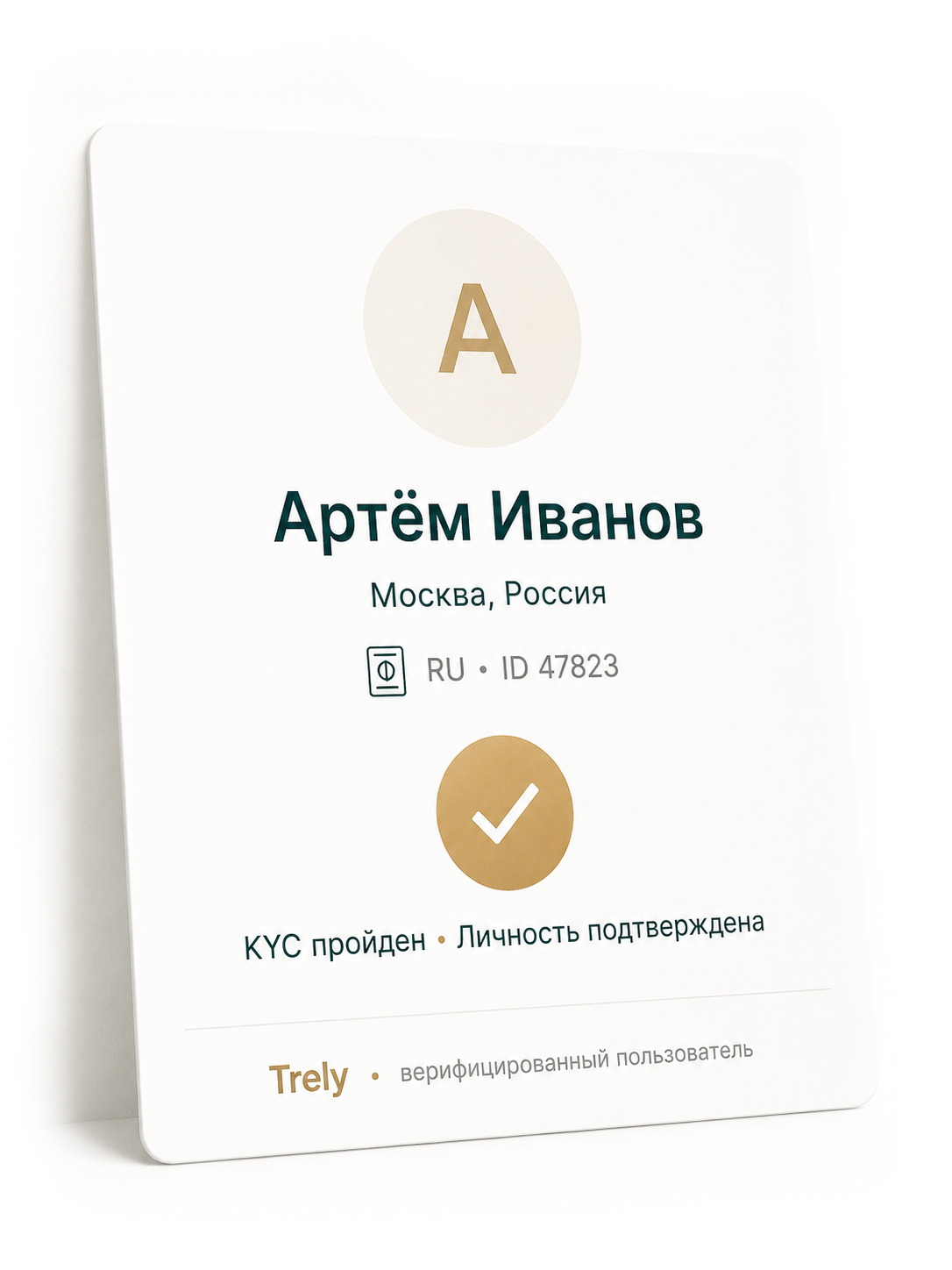
Every user passes a document check and face verification. We have no anonymous profiles.
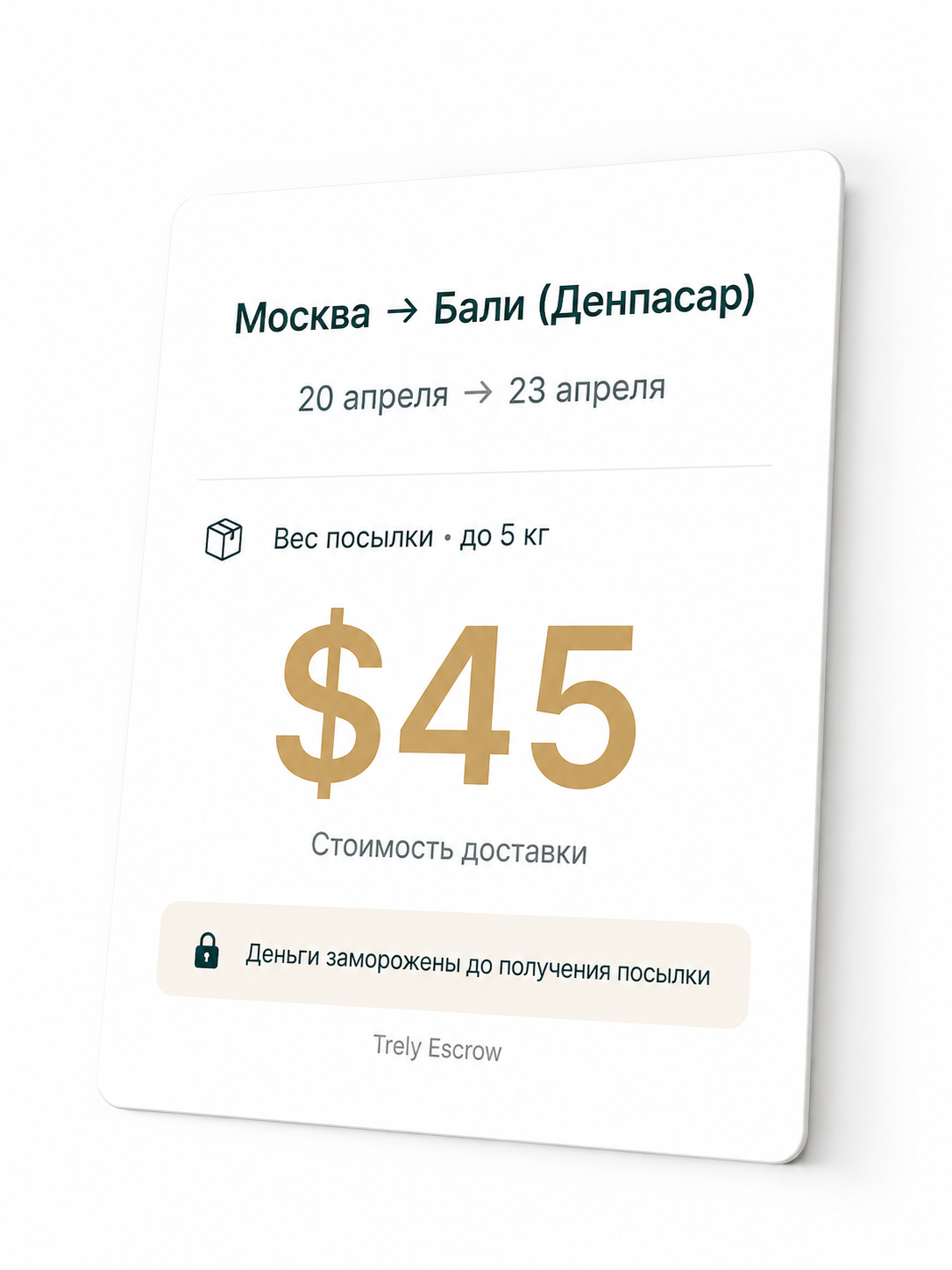
The sender's money is held by Trely and released to the traveller only after delivery is confirmed.
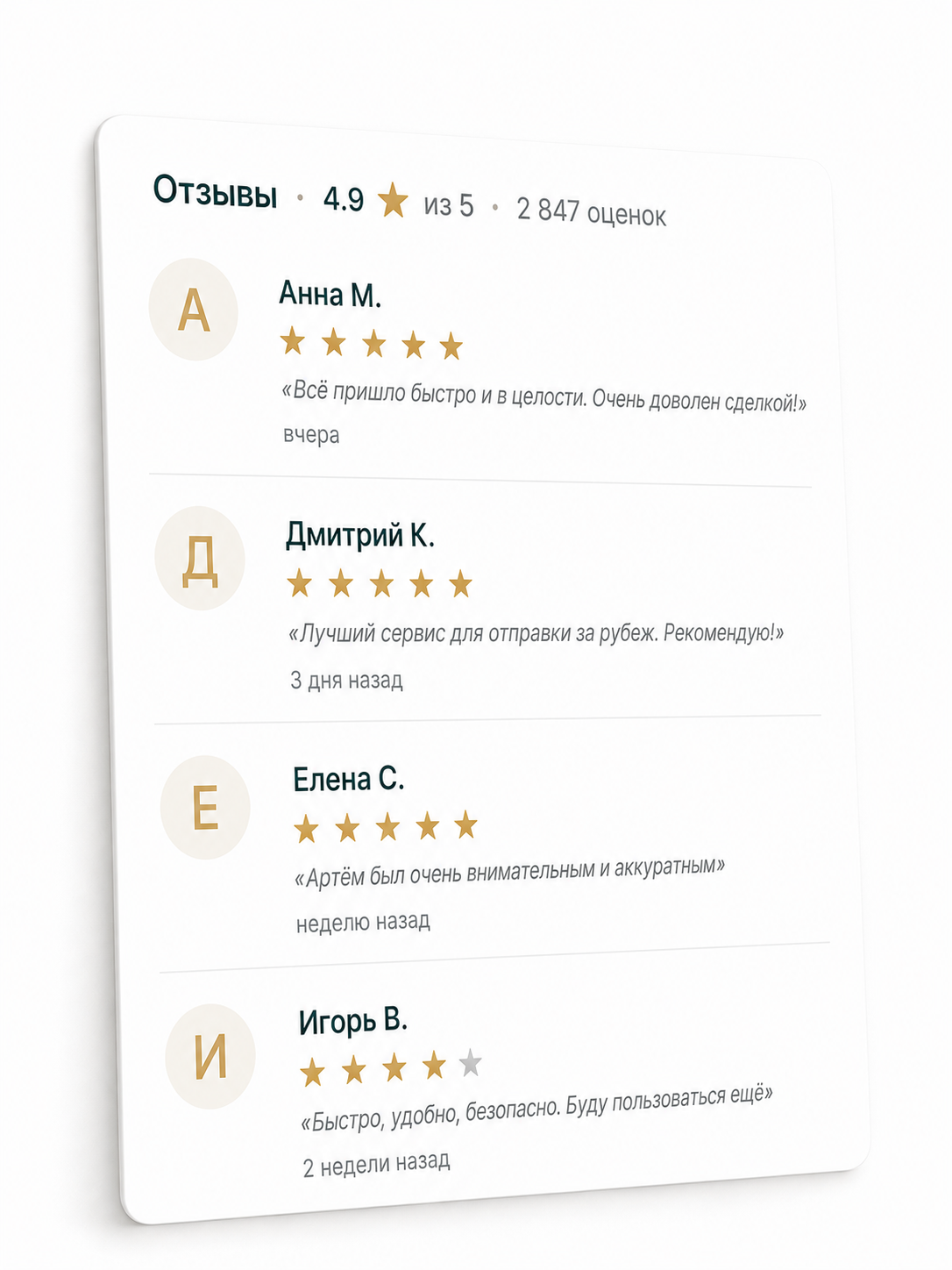
After every deal both sides leave a rating. A profile with a low rating loses access to requests.
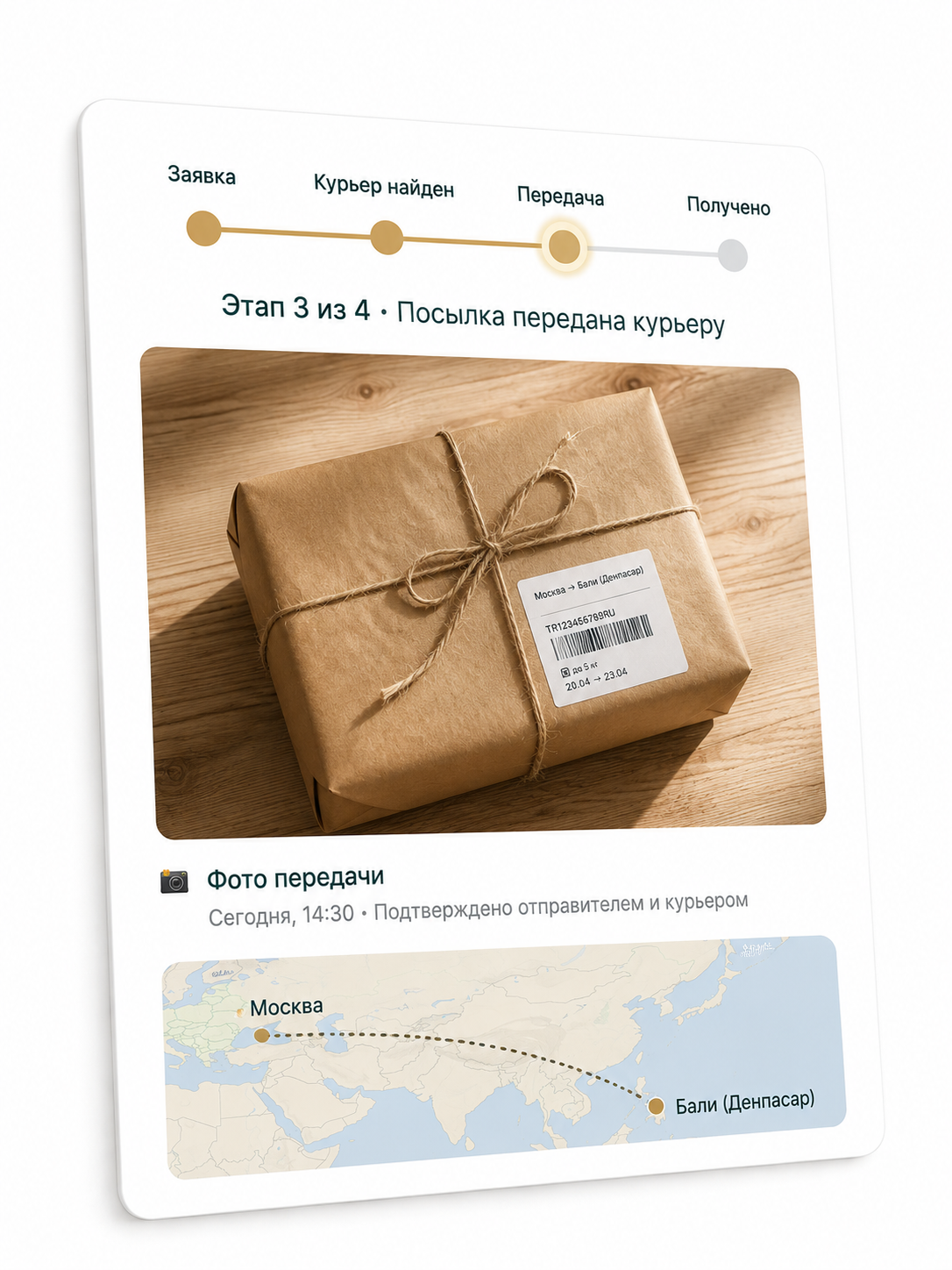
Every step — packing photo, handover, receipt — is recorded in the app. Nothing goes missing without a trace.
Advertising in the Trely ecosystem
110,000+ potential customers for your business. Expats and travellers are the highest-spending audience, looking for your services right now.
3 minutes to create a request — and travellers start responding. KYC, ratings, chat, 24/7 support.